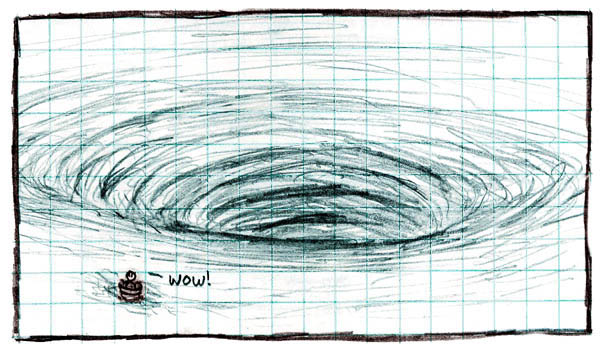
Monday, October 30, 2006

Fire and Ice

A long discussion on sepia mutiny today about science and religion. Reminded me of this poem.

Some say the world will end in fire;
Some say in ice.
From what I've tasted of desire
I hold with those who favor fire.
But if it had to perish twice,
I think I know enough of hate
To know that for destruction ice
Is also great
And would suffice.


Ah, the not so gentle Frost. I wish we saw him more often.

The poem could be an allegory for so many things, but if science is fire and religion is ice, then I'd say it is a tossup between fire and ice.

Friday, October 27, 2006

Constructing HAL

An interesting presentation by Doug Lenat, AI pioneer and founder of cycorp, at google.


Cyc plans to feed all the information in the world into a computer, and then let the computer use first order logic to reason with the information to answer questions. Now before we go all 2001 over this, its interesting that Lenat has been working at it for over twenty years, and the system can now answer questions like 'Is President Bush inhaling or exhaling right now?' correctly, with an 'I don't know'.

To be fair, some of the examples in the presentation are impressive, but is it a victory for AI, or for Moore's law? I am not a great fan of the Deep Blue approach to AI problems. It seems the way to solve an AI problem is to destroy it.

On the other hand, Lenat does point out a very serious problem with gradual learn-by-experience approaches: a Catch-22 situation where the less the system already knows, the harder it is for it to learn further or evolve. So classical AI might be a good bootstrap to give learning systems a headstart. That is actually a very good idea, and I haven't seen anyone doing that.

Thursday, October 26, 2006

Only connect

Nerd Trivia.

Connect the Unabomber, pornography, Lord Byron, and a concurrent programming language.

Answer: David Gelernter

David Gelernter, professor at Yale, and a target of the Unabomber, invented the concurrent programming language Linda, named after Linda Lovelace (the star of Deep Throat) as a twisted sort of joke, as the only other woman to have a programming language named after her is also a Lovelace: Ada, daughter of Lord Byron.

You can't make this stuff up.

Saturday, October 21, 2006

Some of us just go one God further

"Usually they say they were expecting a man in a wheelchair who can't talk. They confuse me with Stephen Hawking.
Is he going to hell too?
I reckon so...
Ya, maybe so, maybe so...God doesn't like black holes..."
Colbert interviews Richard Dawkins.


I idolized Dawkins as a teen, but he is getting a little repetitive. Still, for nostalgia's sake.

Friday, September 15, 2006

A day before the (Moharram) processions were due to take place, a young [Sunni] Saudi prince told me he could not understand why the Shias had to scourge themselves. "The events they are remembering took place long before they were born, and there's no reason for them to blame themselves now because there's nothing they can do to stop what happened."

-Michael Field (Inside the Arab World)

It is gratifying to see how reasonable people can be about religion - if it is not theirs.

Friday, August 25, 2006

In Minstrels Today.

Guest poem sent in by Lakshmi Jagad.

"On Death, without Exaggeration"

It can't take a joke,
find a star, make a bridge.
It knows nothing about weaving, mining, farming,
building ships, or baking cakes.

In our planning for tomorrow,
it has the final word,
which is always beside the point.

It can't even get the things done
that are part of its trade:
dig a grave,
make a coffin,
clean up after itself.

Preoccupied with killing,
it does the job awkwardly,
without system or skill.
As though each of us were its first kill.

Oh, it has its triumphs,
but look at its countless defeats,
missed blows,
and repeat attempts!

Sometimes it isn't strong enough
to swat a fly from the air.
Many are the caterpillars
that have outcrawled it.

All those bulbs, pods,
tentacles, fins, tracheae,
nuptial plumage, and winter fur
show that it has fallen behind
with its halfhearted work.

Ill will won't help
and even our lending a hand with wars and coups d'etat
is so far not enough.

Hearts beat inside eggs.
Babies' skeletons grow.
Seeds, hard at work, sprout their first tiny pair of leaves
and sometimes even tall trees fall away.

Whoever claims that it's omnipotent
is himself living proof
that it's not.

There's no life
that couldn't be immortal
if only for a moment.

Death
always arrives by that very moment too late.

In vain it tugs at the knob
of the invisible door.
As far as you've come
can't be undone.

-- Wislawa Szymborska

Monday, June 26, 2006

"I have known more men destroyed by the desire to have wife and child and to keep them in comfort than I have seen destroyed by drink and harlots."

-W. B. Yeats

I will not stick my neck out and agree with him entirely. But I can see what he was talking about.

Banality kills, faster than booze.

Saturday, June 24, 2006

Thunder Road: The Dirge

Bruce Springsteen has a different version of Thunder Road in his 'Live 1975-1985' collection. It is a tired dirge to youth and ambition, unlike the album version, which was a celebration, powerful and desperate at the same time.

The live version is a distinct song in its own right.


So you're scared and you're thinking
That maybe we ain't that young anymore


You don't believe him when he sings this in the original, but in the live version you do. Springsteen sounds old. And the girl seems much more important.In the album version, he is not talking to the girl. Sure she is addressed, but it is merely incidental. You can see the guy is wrapped up in what the future will bring him. It is Springsteen, of course, and you know that the future did bring him a lot, and the song becomes a huge celebration of that special belief that people have in their uniqueness, which was proven to be true in dear Bruce's case, and when you are young, you think it will be proven in your case too.

The live version came as a shock to me. Coming from Bruce the Boss, it should have been a gloat as much as a song. Who can sing the song with a smugger, more satisfied smile? But it is strange what he makes of it. Was Springsteen disappointed in any way? Well, I would have been too, if I had released such horribly mediocre albums as Human Touch and Lucky Town to follow up Darkness on the Edge!

Kidding. But only partly. We all end up being disappointed to some extent. Not with the world, but with ourselves. We are not the perfect, ideal heroes we see ourselves. As we grow, we catch ourselves lying, cheating, manipulating, compromising, and getting used to the mediocre, and we realize we are no better.

It's a town full of losers
And I'm pulling out of here to win.


Only, you pull into another town of losers. Maybe fewer losers, if you are lucky. But losers, nonetheless.

Yes, I am not exactly upbeat today.

Friday, June 23, 2006

Gieve Patel: Desi Doctor Poet

It takes much time to kill a tree,
Not a simple jab of the knife
Will do it. It has grown
Slowly consuming the earth,
Rising out if it, feeding
Upon its crust, absorbing
Years of sunlight, air, water,
And out of its leprous hide
Sprouting leaves.

So hack and chop
But this alone won't do it.
Not so much pain will do it.
The bleeding bark will heal
And from close to the ground
Will rise curled green twigs,
Miniature boughs
Which if unchecked will expand again
To former size.

No,
The root is to be pulled out –
Out of the anchoring earth;
It is to be roped, tied,
And pulled out-snapped out
Or pulled out entirely,
Out from the earth-cave,
And the strength of the tree exposed,
The source, white and wet,
The most sensitive, hidden
For years inside the earth.

Then the matter
Of scorching and choking
In sun and air,
Browning, hardening,
Twisting, withering,

And then it is done.

- Gieve Patel

A killer of a poem, if you will excuse the lousy pun. I always admired its surgical precision, and today I discovered the poet was a doctor. Another poem by Gieve Patel, I discovered while searching for this one.

it makes sense not
to have the body
seamless,
hermetically sealed, a
non-orificial
box of incorruptibles.

Saturday, May 06, 2006

The Seventh Seal

I saw The Seventh Seal today. It was perhaps Ingmar Bergman's first major movie, and you can tell. Not in the sense that it is an immature or flawed work, but by the theme. The movie is about the Godless universe, the pointlessness of life, the inevitability of death, and the overall stupidity of it all. Only a fresh young film director can decide he shall make a movie that will ask the most important questions ever. And the central premise of the movie is breathtaking in its theatricality - death confronts a knight back from the Crusades in medieval times, and tells him he has to die. The knight challenges death to a game of chess. If he wins, death has to let him go. The very idea: a medieval knight and death play chess for the knight's life. Yet, it does not appear absurd in the movie. In Bergman's words:

'It was a delicate and dangerous artistic move, which could have failed. Suddenly, an actor appears in the whiteface, dressed all in black, and announces that he is Death. Everyone accepted the dramatic feat that he was Death, instead of saying "Come on now, don't try to put something over on us! You can't fool us! We can see that you are just a talented actor who is painted white and clad in black! You're not Death at all!".'

But somehow it does not happen.

One of the best scenes in the movie is where the knight Antonius Block(played by Max von Sydow) visits an old(even by middle ages standards ;) ) church. He goes to confession and death masquerades as the priest(screenplay translation from Swedish, excerpt from here):

The KNIGHT is kneeling before a small altar. It is dark and quiet around him.
The air is cool and musty. Pictures of saints look down on him with stony
eyes. Christ's face is turned upwards, His mouth open as if in a cry of
anguish. On the ceiling beam there is a representation of a hideous devil
spying on a miserable human being. The KNIGHT hears a sound from the
confession booth and approaches it. The face of DEATH appears behind the
grille for an instant, but the KNIGHT doesn't see him.


KNIGHT
I want to talk to you as openly as I can, but my heart is empty.

DEATH doesn't answer.

KNIGHT
The emptiness is a mirror turned towards my own face. I see myself in it, and I am filled with fear and disgust.

DEATH doesn't answer.

KNIGHT
Through my indifference to my fellow men, I have isolated myself from their company. Now I live in a world of phantoms. I am imprisoned in my dreams and fantasies.

DEATH
And yet you don't want to die.

KNIGHT
Yes, I do.

DEATH
What are you waiting for?

KNIGHT
I want knowledge.

DEATH
You want guarantees?

KNIGHT
Call it whatever you like. Is it so cruelly inconceivable to grasp God with the senses? Why should He hide himself in a mist of half-spoken promises and unseen miracles?

DEATH doesn't answer.

KNIGHT
How can we have faith in those who believe when we can't have faith in ourselves? What is going to happen to those of us who want to believe but aren't able to? And what is to become of those who neither want to nor are capable of believing?

The KNIGHT stops and waits for a reply, but no one speaks or answers him. There is complete silence.

KNIGHT
Why can't I kill God within me? Why does He lives on in this painful and humiliating way even though I curse Him and want to tear Him out of my heart? Why, in spite of everything, is He a baffling reality that I can't shake off? Do you hear me?

DEATH
Yes, I hear you.

KNIGHT
I want knowledge, not faith, not suppositions, but knowledge. I want God to stretch out His hand towards me, reveal Himself and speak to me.

DEATH
But He remains silent.

KNIGHT
I call out to Him in the dark but no one seems to be there.

DEATH
Perhaps no one is there.

KNIGHT
Then life is an outrageous horror. No one can live in the face of death, knowing that all is nothingness.

DEATH
Most people never reflect about either death or the futility of life.

KNIGHT
But one day they will have to stand at that last moment of life and look towards the darkness.

DEATH
When that day comes ...

KNIGHT
In our fear, we make an image, and that image we call God.


Wow!

Quoting Larkin:

'And saying so to some
Means nothing; others it leaves
Nothing to be said.'

For me it was the latter.

Saturday, March 18, 2006

Rang De Basanti

I always thought there were two kinds of men in this world; those who go to their death screaming, and those who go to their death in silence.
Then I met a third kind.


The movie rocks!

the four years...THE four years...

A part-proxy Post: Courtesy Deepu

It has been aeons now and we started off at a time, which in hindsight, almost seems like some long-lost childhood.

Dodging the ragging sessions of seniors to the bullets of the STASI like police force; countless hours spent in idle planning about elusive treks across the length and breadth of the country; late efforts to hurdle across insurmountable-looking barriers for REC tests and then even latter minute decisions to give it all up for another session of idle gossip on esoteric topics from Alexander to Mobutu Sese Seko; planning dilettanteish endeavours ranging from breathing life to the dying embers of the quizzing culture at REC to still-born attempts at creating literary magazines and then scaling down our literary ambitions to a successful launch of a raunchier one; dumb charade competitions to forming a crack quiz team, which roared in the halcyon days and bowed out unfortunately with a quiet meow; emulating Lance Armstrong on our home stretches - the Ring Road; expanding our knowledge of ourselves with impromptu folk dance performances; the first session of Rum and Coke in the hallowed precincts of B-69; the rave sessions of bacchanalian merrymaking at Hotel Radhika; star-crossed hillocks which would go on to name this Yahoogroup; cycling to Mandira Dam and back in a 50 km cyclathon; Dolo Gobindo Sahoo and the Ranga-Kutta methods which makes the eponymous wedding boy what he is today; snipping off bullet-ridden jeans until they became your first acquisition of designer denim briefs; the highs and lows of the campus period;Buddykoti and myself striving hard to outdo each other on Mess Charges and occasionally on the lawns of Hall-3 as we fought over the rights of use of a Bhutanese owned cycle;load-shedding induced musical soirees on the corridors of successive hostels; the thousand mistrusts with Boney M over a whole lot of issues; Vishy boy being made to do the laps of the stadium as the 'Gunduest' of us all during ragging to the countless bangs that your fists had to endure to wake up Kumbhakarna from the arms of Morpheus; the 'bald-pate' fashion statement which elevated REC-Rourkela to the forefront of inter-REC haute-cotoure initiatives; cycling across the mountains behind Hall-5 and slipping into wilderness between empty snake-skins and mountains that seemed as if they were from Middle Earth; the first endless night of conversation in Hall-1 46 about puppy love episodes; the change of address of Suratna to the romantic alcove of the REC library as Cupid struck hard; morning shows at Konark and the libido-induced mass rush of Hall-1 to the Kama Sutra in the middle of Sem-1 exams; German club books and election strategies - phew!

And Ranga's endless wall-staring sessions(someday I expected him to start talking to it); the six week hiatus when we resolved not to discuss girls,and did not; the 3 days after that when we talked nothing except girls; Ranga and I forming an antakshari team, clearing the prelims to end the main rounds at MINUS five; Fredrick Wright's insufferable audio rounds; the depression in the civil(ranga, boney and vishy) camp, with SSPP saying aye to Kalia; our first quiz at REC(Hall-3 with Subrat), a day before the ED submission; surdie's eternally fathomless gyan on life, women and Nietzche; acting out Tierra del Feugo and god-knows-what-else for Dumb Charade practise; Deepu's indiscriminate beliicosity, including antagonists like Ratul and Swagat; his final revenge on Variyar; the tragi-comic sinedie; the Spice tent and the free cake coupons; the all night walks through Kharagpur; Ranga as Reading Room Sec, and the lurid magazines; the 250-odd times we listened to Bada Din on that odd contraption....
And on and on and on... Some of the above would perhaps be decipherable only to some and some others may just have become corrupted files in your memory due to non-use over the years - but we have the Aegean stables here of memories and we haven't even scratched the surface of the Pune ones. Guys, TheSadKaffe was created to keep rejigging the memories of the past and celebrate the togetherness that we created. It has been nearly 8 and a half years of knowing each other inside out and I guess, all of us have in a whole lot of unusual and queer ways, become a part of each other.

Vishy's marriage happened in a bit of a hurry and Wally, old boy and Priya, my sincere apologies for not having the time to pen down something in those maddening, frenzied days of B-School life. But as Ranga readies to tie the knot, I feel happy in a very quaint sort of way - almost as if the years are beginning to tell upon you and the feeling of an epochdawning and another setting. Don't know if I have been able to put it forth aptly, but I thought that I will scribble a few lines about the old days and hope, it brings a welcome whiff of nostalgia and a thin smile on the faces of all you hopeless bunch of baboons. Cheers RANGA boy and from everybody at TheSadKaffe, congratulations and best wishes.

Add a toast to THE SADKAFFE and all that it stands for.P.S. And to think of it,"Ranga" was never his name.

Monday, March 06, 2006

Yet each man kills

Yet each man kills the thing he loves
By each let this be heard,
Some do it with a bitter look,
Some with a flattering word,
The coward does it with a kiss,
The brave man with a sword!

- Oscar Wilde


If you put the words kill and love in the same stanza, I guess you cannot go wrong.
It gets better.


Some kill their love when they are young,
And some when they are old;
Some strangle with the hands of Lust,
Some with the hands of Gold:
The kindest use a knife, because
The dead so soon grow cold.

Some love too little, some too long,
Some sell, and others buy;
Some do the deed with many tears,
And some without a sigh:
For each man kills the thing he loves,
Yet each man does not die.

Too many have lived

Too many have lived
As we live
For our lives to be
Proof of our living.


Too many have died
As we die
For their deaths to be
Proof of our dying


A story by Dashiell Hammett begins with these lines. It was in a detective story collection I had. Far as I remember, I never read the story. But the lines would jump out of the book, eight lines of verse in a book containing approximately eighty murders.

Its cliched and teenagish. But like some people are suckers for romantic comedies, I am a sucker for this kind of stuff. I am quite the armchair revolutionary.

Saturday, December 03, 2005

Tuesday, September 27, 2005

The answer my friend...

There is the old Indian debate about arranged marriages vs love marriages. I always think it is a stupid debate...I mean, you do not decide you want a love marriage, and then go out looking for ways to get into one...if you do, it is probably more arranged than love...but there is another more interesting debate....is it a good idea to do the running-away-from-home thing to marry someone you want to marry?...how much is the 'love-of-your-life' thing really worth?

Love is a way too overrated emotion. It was the supposed grand solution to all of 20th century woes...perhaps like religion was before that...and its likely to continue that way...mainly through lack of competion...'I stand alone without beliefs, The only truth I know is you.'...how simple and comforting...to put your faith in 'you'...some you...

But if you have to do something for the 'you'...how far is it a good idea to go?...to damage relationship with your family, etc etc?....especially if their objections are the pointless ones...like community, religion, etc?....I think at this point it has nothing to do with the love thingie....it is about the type of person you are...if you are the pragmatic type, maybe you would not really want all that trouble...if you are the rebel, you might just go ahead and do it for the kick, and for the inevitable round of envy and applause...

I guess I am too cynical....yeah, I am...but then, life is a bore, and if you expect you will find someone who will make it endlessly exciting for you...well, good luck to you, and you will be the first ;) ....

I met someone today who wanted a) to do a PhD, b) marry someone he/she loves...and the family does not agree on either option...my advise would be...do both if you can...but drop the person if you have a choice, and go for the PhD...for a broken heart will mend...but a job you don't like...that really really sucks....

Thursday, August 25, 2005

Doing a Larkin.

Let me post my own attempt to do a Larkin, that is, try to recreate a fleeting feeling in verse.

Were we introduced again,
I will not stand frozen hapless,
Like someone caught in sudden rain.


Ok, its not a great poem. But its my blog.

Larkin's 'Coming'

There are few things more difficult in poetry than to bring alive a single moment, a single feeling, just as it was felt, before it disappeared. Larkin is the master of the epiphany.

No poet creates a moment as effectively as Larkin does. It is this skill that makes him such a great artist, and lacking this talent, his poems will get tiresome. You meet the cynical old man in every poem, whose childhood is dull, the people he meets superficial and unworthy of consideration. Yet he has an appeal, because this grouchy old man observes the world stripped of all pretension.

I have a strange favourite among Larkin's poems - Coming.

On longer evenings,
Light, chill and yellow
Bathes the serene
Foreheads of houses.
A thrush sings,
Laurel-surrounded
In the bare deep garden,
Its fresh-peeled voice
Astonishing the woodwork.

It will be spring soon,
It will be spring soon-
And I, whose childhood
Is a forgotten boredom,
Feels like a child
Who comes on a scene
Of adults reconciling
And can understand nothing
Except the unusual laughter,
And starts to be happy.


It is not as popular as some of his other works, but I still love it more, as it brings to life this moment where you are alone somewhere with nature, and you feel its beauty, but at the same time its mysteriousness. Just like a child who feels happy on seeing adults around him happy, though does not always understand why.

But Larkin could not keep the grouchy old man out of this poem either.

And I, whose childhood
is a forgotten boredom.


Some people never change.

Tuesday, July 26, 2005

tv

Caught some TV yesterday. Friends. Yeah, people exist who haven't watched Friends. Or they did, till yesterday.

One sequence reminded me of of a similar one from Frasier, where the dad has an extra $100 credit to his account. Miles asks him to return the money and he answers: 'Are you kidding? This is America. An entire nation built on the principle of finders keepers!'

Over to Friends, where one of the girls(don't ask me names, I don't remember) has an extra credit of $500 in her bank account. Someone asks her to go shopping with it, and she says, 'No, I can't. If I buy a pair of shoes with the money and I walk down the street in them, all I will hear as I walk is "not mine! not mine! not mine!'"

I think the Frasier joke was better.

Saturday, July 23, 2005

darkness at noon.

Started Koestler's Darkness at Noon yesterday evening. Yeah, its my old problem. Reading too many books together at the same time. But its interesting to read it side by side with Gorky Park. Both deal with the Soviet Union, but their heroes(or rather protagonists, as Rubashov, of Darkness, is not exactly heroic) cannot be more different. Arkady Renko is the man who refused to sell his soul. He is not burning with hatred for communism; he is probably too old and tired, and past all that. But he cannot take all that party and revolution and workers' paradise talk seriously. Its a farce to him. So he simply avoids anything to do with the party as far as possible, and sticks to his job as detective. That is a realistic potrayal of the closest one could come to dissidence in Soviet Russia.

Rubashov of Darkness at Noon is almost comical in comparison, with his faith in the future and how the Party will take the world to a new paradise.

When the novel starts he is locked up in a cell waiting for interrogation. He is finally caught in the net in one of the purges under No.1 (Stalin, I guess). So he broods intermittently over his past and over a toothache(Koestler very effectively uses the toothache as a symbol for his discomfort over things Rubashov did for the party in the past). And all through his brooding, he wonders about - and this is the theme of the book - whether the ends justify the means. This is supposedly the central problem in the book. But I think the way problems should be defined, it is a very badly defined problem.

For one, the ends, the way Rubashov describes them, are laughable. He believes that the revolution is 'with' the forces of history, and it will create a completely just society and a paradise on earth for the masses. Now, such ends- okay, this sounds a little too scientific- are not quantifiable at all! How do you measure the justness of a society? How do you know when you have reached a completely just one? Anyone who believes such ends is simply deluding himself, cos he himself will not know even if he has reached those ends. And even if he does, how will he prove it to others? Darkness is a good book if you want a peek into the mind of a failed Communist, but as a general book raising question of ends vs means, I think it fails.

To define a good 'ends vs means' problem, we need a situation where the ends can clearly be seen, be measured, to be good. Then we can think about the means. A science fiction work may define the problem more clearly.

Suppose you have a planet where people exist with two kinds of mutations. Some have one heart, some have two. Now, the people with one heart can live easily with one, but the people with two hearts, their bodies are used to twice the pumping since birth, can only survive if they have two hearts. Suppose a 100 people on this planet(all with one heart) are about to die of heart failure. Should you round up 50 2-hearted people (at random) and use their hearts for transplant, and save 50 lives on balance?

Ok, all that was a little creepy. But it attacks the means vs ends question with more clarity, cos at least you know the ends are measurably better. Not some vague workers' paradise in the future.

You can solve a tough problem, but what you can never solve is a badly defined problem. That is what I don't like about Darkness at Noon. It would have been fine if Koestler had stuck to depicting communism and why he hated it. But to set it up as an example where the means failed to justify the ends seemed taking it a little too far.