Showing posts with label Movies. Show all posts

Wednesday, August 15, 2007

Kagemusha: a confused review


I was afraid I will not like Kurosawa's Kagemusha (The Shadow Warrior), and in a way, I was right. At 180 minutes, it takes its time, including a five minute sequence where a character (who is not seen again) does little besides clean and load his gun, and another where the future king of Japan gets up and does an impromptu Noh dance. But it still is a haunting film, about the dynamic between individualism and collectivism. The most intriguing part is that Kurosawa refuses to side with individualism: rather his sympathies (I think) tacitly seem to lie with the other side. That certainly is a bummer: which was the last movie you saw where the hero was not a rebel of some sort.

The movie starts with a thief (who remains unnamed) being brought before the Samurai lord Shingen Takeda, by his brother Nabukado. The thief has a close resemblance to Shingen and will be useful as a body double. This saves the thief from the fate, crucifixion, that he was intended for, but he is unimpressed. He boldly confronts the warlord and tells him that a man who has robbed and killed thousands cannot be a judge of his petty crime. However, soon, the warlord is dead and the thief is required to take his place. He is reluctant: he cannot live a lie, plus he wants his old life back. But he agrees when he realizes that his refusal might well spell the end of the Takeda clan. He is not of the clan, but he also wants to be useful, to have served a purpose, even if that means living a lie.

The movie at this point touched a raw nerve with me: the dilemma that anyone who grew up in a traditional society like Japan, or India, faces. The choice between the role we are expected to play as part of the society we are born in, and our sense of independence. This is not so true of my generation, but I meet so many people from my father's generation and above who spent their lives playing roles they felt they were born into: the good son, the good husband and father, the perfect wife. And like the thief they play the roles so well, they become these roles, and sometimes you cannot tell if there is a real person besides the role. Did they all make a conscious decision at some point to play the role?

Kurosawa sees the tragedy in this, but a certain dignity. As Nabukado, who occasionally played his brother's double himself, tells the thief:

I was for a long time the lord's double. It was torture. It is not easy to suppress yourself to become another. Often I wanted to be myself and free. But now I think this was selfish of me. The shadow of a man can never desert that man. I was my brother's shadow. Now that I have lost him, it is as though I am nothing.


Kurosawa identifies with the loss of individuality, but at the same time sees a dignity in accepting the role. To accept it is to live with the satisfaction that you have done your duty: there may not be happiness, but there is a certain sense of meaning. To not do so is to be selfish. But selfishness is such an old world sin ;) .

The movie ends in tragedy, with a final battle sequence, where the arrival of modern guns signifies an end to the traditional Samurai way of life. The Kagemusha dies trying to stay true to his illusion even though it no longer matters: his secret is out. What is Kurosawa trying to say? Is it a heroic death, or a pathetic one? I went with pathetic, but someone with different cultural assumptions might see a heroism in that tragedy. In fact, I have a feeling my father and I will disagree :).

Perhaps the point is the ambiguity: that every culture has its own tacit assumptions, and not realizing those assumptions means talking past one another. Is that what Kurosawa is trying to say?

I give up ;) .

Thursday, March 15, 2007

300

If Manoj Kumar made a movie about Prithviraj Chauhan starring Sunny Deol, it would be like 300.

Except they probably would not depict Muhammad Ghori as an eight foot giant of ambiguous sexuality.

There's a lot of discussion on the web about the politics of the movie. No one seems to be surprised by how breathtakingly inane the screenplay is. I mean, we do call comics 'graphic novels' now, don't we. And Frank Miller is supposed to be some kind of graphic novel god.

Yes I know, its just an action movie and not supposed to be taken seriously. Someone should have told the director that.

PS: Sneaking suspicion: Am I getting too old for this kind of stuff?

Monday, February 12, 2007

I swear on the bones of Charles Darwin....


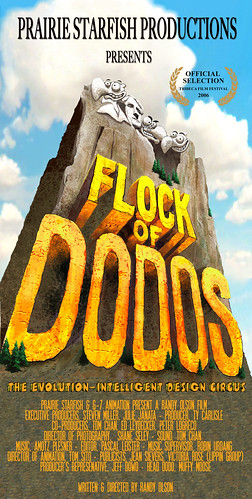
One evolutionist actually does say that in Flock of Dodos. In his defense, a) he is drunk, and b) he is very very angry.

Directed by Randy Olson, evolutionary biologist and two-time TA for Stephen Jay Gould, Flock of Dodos tries to understand why, what should have been game-set-match for the evolutionists, is running into tie-breaker after tie-breaker.

Olson thinks it is because most scientists are ugly, don't suffer fools, don't look good on TV, and couldn't speak in 'talking points' to save their lives.

Intelligent Design proponents, on the other hand, seem to speak only in talking points. Every ID fan Olson talks to raises the same arguments, such as, how just as anyone can tell that Mount Rushmore has to be intelligently designed, it is obvious that life too is, then some platitudes about irreducible complexity, and claims that biologists intentionally lie and mislead (picked from Wells' Icons of Evolution). On the other hand, they are always nice, never condescend, some even carry around helpful little photographs of Mt. Rushmore with them to make their point. The ones you get to meet are bearded old gentlemen or loving grandmas (all the bible thumpers having been pushed to the back pews).

Olson makes this point wonderfully when he asks a scientist (I forget who), "Their catchphrase is teach the controversy. What is your catchphrase?" The scientist is stumped, "Catchphrase?" Ultimately he comes up with 'Teach the Science', which is not so bad, if only someone used it.

The best part about Flock of Dodos is that it is constantly funny, never takes itself seriously, and remembers its own lesson and never condescends.

And yes, Happy Darwin Day.
If people remember your 198th birthday, that is a very special achievement.

Friday, November 03, 2006

Match Point


"It would be fitting if I were apprehended... and punished. At least there would be some small sign of justice - some small measure of hope for the possibility of meaning."
I liked Match Point, what seemed like Woody Allen's interpretation of Crime and Punishment. Though the movie does not see any final redemption for its Raskolnikov. As a character scoffs: 'Faith is the path of least resistance'.

It does come across as pretentious at a couple of points, but I am willing to tolerate a hint of pretension, so long as a movie is interesting.

The Woody Allen movie I disliked was Manhattan, which was pretentious about quite stupid things.

Saturday, May 06, 2006

The Seventh Seal

I saw The Seventh Seal today. It was perhaps Ingmar Bergman's first major movie, and you can tell. Not in the sense that it is an immature or flawed work, but by the theme. The movie is about the Godless universe, the pointlessness of life, the inevitability of death, and the overall stupidity of it all. Only a fresh young film director can decide he shall make a movie that will ask the most important questions ever. And the central premise of the movie is breathtaking in its theatricality - death confronts a knight back from the Crusades in medieval times, and tells him he has to die. The knight challenges death to a game of chess. If he wins, death has to let him go. The very idea: a medieval knight and death play chess for the knight's life. Yet, it does not appear absurd in the movie. In Bergman's words:

'It was a delicate and dangerous artistic move, which could have failed. Suddenly, an actor appears in the whiteface, dressed all in black, and announces that he is Death. Everyone accepted the dramatic feat that he was Death, instead of saying "Come on now, don't try to put something over on us! You can't fool us! We can see that you are just a talented actor who is painted white and clad in black! You're not Death at all!".'

But somehow it does not happen.

One of the best scenes in the movie is where the knight Antonius Block(played by Max von Sydow) visits an old(even by middle ages standards ;) ) church. He goes to confession and death masquerades as the priest(screenplay translation from Swedish, excerpt from here):

The KNIGHT is kneeling before a small altar. It is dark and quiet around him.
The air is cool and musty. Pictures of saints look down on him with stony
eyes. Christ's face is turned upwards, His mouth open as if in a cry of
anguish. On the ceiling beam there is a representation of a hideous devil
spying on a miserable human being. The KNIGHT hears a sound from the
confession booth and approaches it. The face of DEATH appears behind the
grille for an instant, but the KNIGHT doesn't see him.


KNIGHT
I want to talk to you as openly as I can, but my heart is empty.

DEATH doesn't answer.

KNIGHT
The emptiness is a mirror turned towards my own face. I see myself in it, and I am filled with fear and disgust.

DEATH doesn't answer.

KNIGHT
Through my indifference to my fellow men, I have isolated myself from their company. Now I live in a world of phantoms. I am imprisoned in my dreams and fantasies.

DEATH
And yet you don't want to die.

KNIGHT
Yes, I do.

DEATH
What are you waiting for?

KNIGHT
I want knowledge.

DEATH
You want guarantees?

KNIGHT
Call it whatever you like. Is it so cruelly inconceivable to grasp God with the senses? Why should He hide himself in a mist of half-spoken promises and unseen miracles?

DEATH doesn't answer.

KNIGHT
How can we have faith in those who believe when we can't have faith in ourselves? What is going to happen to those of us who want to believe but aren't able to? And what is to become of those who neither want to nor are capable of believing?

The KNIGHT stops and waits for a reply, but no one speaks or answers him. There is complete silence.

KNIGHT
Why can't I kill God within me? Why does He lives on in this painful and humiliating way even though I curse Him and want to tear Him out of my heart? Why, in spite of everything, is He a baffling reality that I can't shake off? Do you hear me?

DEATH
Yes, I hear you.

KNIGHT
I want knowledge, not faith, not suppositions, but knowledge. I want God to stretch out His hand towards me, reveal Himself and speak to me.

DEATH
But He remains silent.

KNIGHT
I call out to Him in the dark but no one seems to be there.

DEATH
Perhaps no one is there.

KNIGHT
Then life is an outrageous horror. No one can live in the face of death, knowing that all is nothingness.

DEATH
Most people never reflect about either death or the futility of life.

KNIGHT
But one day they will have to stand at that last moment of life and look towards the darkness.

DEATH
When that day comes ...

KNIGHT
In our fear, we make an image, and that image we call God.


Wow!

Quoting Larkin:

'And saying so to some
Means nothing; others it leaves
Nothing to be said.'

For me it was the latter.

Saturday, March 18, 2006

Rang De Basanti

I always thought there were two kinds of men in this world; those who go to their death screaming, and those who go to their death in silence.
Then I met a third kind.


The movie rocks!