Showing posts with label Science. Show all posts

Friday, October 19, 2007

The Indian Clerk: A review

"Ramanujan says nothing. Instead he rests his head against the pillow and turns, once again, to look at the river. And Hardy wonders: from his starting place, from the pial at twilight, could he have traveled further."
The eponymous 'Indian Clerk' in Leavitt's novel is Ramanujan, but 'The Cambridge Don' would perhaps have been a more apt title for the book, as the book is much more about Hardy. Ramanujan remains a cipher throughout the book: his inner thoughts are never presented by the author. It is Hardy we get to know really well.

However, in another sense, The Indian Clerk is very much about Ramanujan, in showing how even the most brilliant among us are ultimately dependent on the systems and institutions that govern our lives. It takes the First World War to bring out the full capriciousness and cruelty of the British institutions. Hardy is careful not to make his pacifism too overt during the War, for fear of losing his fellowship. Many see him as a coward, and he watches Russell and Eric Neville lose their fellowships at Cambridge for their pacifism. Russell can afford to, but Neville is a lesser talent, mathematically and otherwise, and is soon forgotten. Their tragedy is of course nothing compared to the tragedy of the men dying at the front. Hardy befriends one of them, called Thayer, and has a short homosexual affair with him. However, he is always embarrassed by his sexuality, as well as Thayer's social class, and can never bring himself to treat Thayer as an equal. As someone from a family of schoolteachers who moved up by navigating the system, he does not have the same insouciance towards it as his peers Russell and Littlewood have. As Hardy muses as he watches his dying mother's ravings:

"She speaks of school. And why not? All her life she has spent in schools. Both she and his father. From Ramanujan's perspective, there must be little difference between him and Littlewood, him and Russell. All are children of affluence to him. And how can he be expected to recognize what separates Hardy from the others? For Littlewood comes from a Cambridge family; Russell is an aristocrat. Whereas Hardy is merely the child of teachers...Hardy is dependent on Trinity, just as his father was dependent on Cranleigh, his mother on the Training College, his sister on St. Catherine's. The only difference is one of prestige. Without the support of munificent institutions, all of them would be lost."
Of course no one knows the cruelty of institutions better than Ramanujan. Ramanujan's story is often told as one of 'genius will out', but that is a fallacy: essentially a self-fulfilling prophecy. Ramanujan's genius for all practical purposes does not exist till he gets the seal of approval from Hardy, who in turn got his seal from Cambridge. No one sees it better than Ramanujan, who, even after building his reputation, wants the B.A. he was never granted by the education system in India. He hopes one of his papers will win him the Smith's Prize, a prize for undergraduates. This irritates Hardy, because Ramanujan's work is far above the prize. But the reality is that he doesn't have the Smith's Prize: he wants the prizes, else he is not a genius, not even to himself.

Hardy takes a long time to realize this. Their relationship for a long time is one of mutual incomprehension. Hardy has a strong perception of himself as an underdog. He identifies with other underdogs, he likes to 'save' them, the way he saved himself with his own brilliance. But his self-absorption, combined with an acute sense of his own status in the class hierarchy, does not make him a very good savior. It takes him a long time to understand Ramanujan's demons are much more severe than his own: his lack of formal achievements and medals, his difficulties and inadequate appreciation of formal proofs in mathematics, a sense of wasted years, his distance from his family, his constant sense of being an outsider, or even his Hinduism that forces him to a vegetarian diet difficult to maintain in wartime Britain. Ultimately Hardy and Ramanujan manage to form some sort of personal bond beyond the professional relationship they had, and Hardy helps him achieve a part of his hopes (against strong racist opposition from Trinity). But the war ends soon after, and Ramanujan wants to go back to India.

The novel is about a lot of other things besides Hardy's relationship with Ramanujan: the troubled life of John Littlewood, the Cambridge Apostles, Russell's activism during wartime, Hardy's atheism, his relationship with his sister, and a (probably fictitious) unrequited love Alice, Eric Neville's wife, has for Ramanujan. I was dissatisfied with his potrayal of Hardy's atheism: it seemed too formulaic. Also, Leavitt seems to make Hardy colder than he perhaps actually was. Anyone who has read 'A Mathematician's Apology' cannot help feeling a certain affection for Hardy's love of mathematics. This love does not come across in his potrayal by Leavitt.

But ultimately the book is not about mathematics. It is about a certain period in English life, when the political and social hypocrisies of the empire were unraveled by an inglorious war. It is also about how the systems and institutions of the time did not treat its greatest minds very differently from how they treated the callow youngsters sent to the front. In this aim it succeeds marvelously.

"And the amazing thing was that they never let him [Thayer] go. They would break him, and send him home for repair, and break him again. In much the same way, I realized later, we broke Ramanujan, and patched him together again, and broke him again, until we had squeezed all the use we could out of him. Until he could manage no more.

Only then did we let him go home."

Thursday, April 12, 2007

Breaking news

A daddy's disappointment to beat Abhishek Bachchan and Julian Lennon.

It appears that the closest living relative to Tyrannosaurus Rex is the humble Gallus domesticus.

Tuesday, April 10, 2007

The answer my friend...umm, nevermind!

Robert Lucky recently had a short opinion piece in Spectrum, where he confirms an uncomfortable feeling I've had for a long time:

'Many questions following technical talks seem intended more to show the expertise of the questioner than to elicit information.'


I am glad I am not the only one who thought so. Lucky has a few other observations:

'The (typical) question goes something like this: “Are you aware of the work on this subject by Professor John Blutarsky at Faber College in 1962?”...“Oh, yes, that Blutarsky,” you say, playing for time. “It’s been some time since I studied his work, but I believe that his assumptions were quite different, and we all know how much technology has changed since then.”...There is an uneasy stirring as people crane their heads to view the questioner. Who is this expert who is familiar with Blutarsky, whose obviously important work the speaker seems not to know?'


There is another category of questioners: those who don't want the speaker to leave with the impression that no one was listening. So a few questions are raised about obvious drawbacks/extensions to the work, something along the lines of 'have you considered the case when k=0', or 'how will your approach do if conditions z hold'. The speaker might then explain that they were not really focusing on the k=0 problem, though with some modifications, it might be possible to get reasonable results. Of course no one really cares what those modifications might be: they are just relieved that the talk did not end in the question-free zone. That would be bad karma.

You can read Lucky's article here.

Saturday, February 17, 2007

A Star is Dead


One of the most impressive discoveries was the origin of the energy of the stars, that makes them continue to burn. One of the men who discovered this was out with his girl friend the night after he realized that nuclear reactions must be going on in the stars in order to make them shine. She said "Look at how pretty the stars shine!"
He replied, "Yes, and right now I am the only man in the world who knows why they shine."

- Richard Feynman, The Feynman Lectures
I always envy people who can identify constellations, an ability I have never been able to develop beyond the basic Ursa-major level. But it must be good to have friends up there, so, when you look up, you can give Auriga, or some other constellation you recognize, a good-natured wave or a pranaam(which will duly reach in 5000-odd years), before carrying on with this tale told by an idiot.

I was fortunate to be working on a project with a few astronomers for a while, and their passion sort of rubs off. I am still not on talking terms with the stars. The good news is that I now enjoy gaping at those pretty pictures as much as the next yokel.

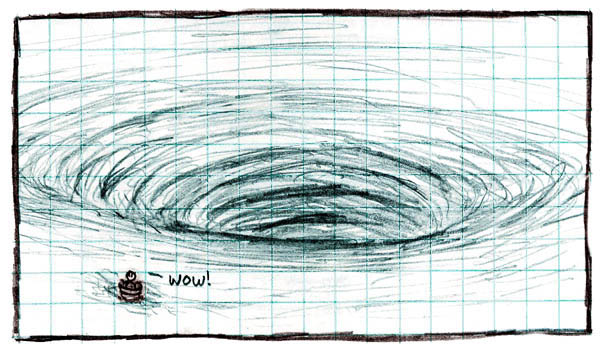
Hubble snapped the picture above yesterday, of an extremely photogenic white dwarf around 4000 light years away.

You might remember that the Sun will die as a white dwarf too, but now you get to see it. The barely visible white dot in the middle will be the Sun(shrunk to the size of earth), and the glittering expanse of millions of miles of gases, a mixture of helium, oxygen, nitrogen and hydrogen, smoking hot at around 200,000 C and emitting ultraviolet rays, will easily reach earth.

Trust a poet to get it wrong: the world will end with a bang after all.

Check out Hubble's website for truly awe-inspiring photographs.

Monday, February 12, 2007

I swear on the bones of Charles Darwin....


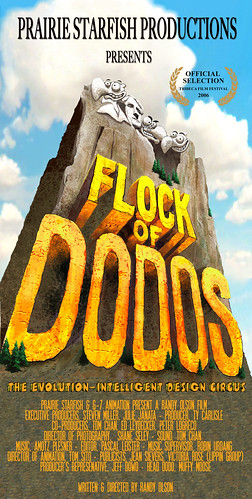
One evolutionist actually does say that in Flock of Dodos. In his defense, a) he is drunk, and b) he is very very angry.

Directed by Randy Olson, evolutionary biologist and two-time TA for Stephen Jay Gould, Flock of Dodos tries to understand why, what should have been game-set-match for the evolutionists, is running into tie-breaker after tie-breaker.

Olson thinks it is because most scientists are ugly, don't suffer fools, don't look good on TV, and couldn't speak in 'talking points' to save their lives.

Intelligent Design proponents, on the other hand, seem to speak only in talking points. Every ID fan Olson talks to raises the same arguments, such as, how just as anyone can tell that Mount Rushmore has to be intelligently designed, it is obvious that life too is, then some platitudes about irreducible complexity, and claims that biologists intentionally lie and mislead (picked from Wells' Icons of Evolution). On the other hand, they are always nice, never condescend, some even carry around helpful little photographs of Mt. Rushmore with them to make their point. The ones you get to meet are bearded old gentlemen or loving grandmas (all the bible thumpers having been pushed to the back pews).

Olson makes this point wonderfully when he asks a scientist (I forget who), "Their catchphrase is teach the controversy. What is your catchphrase?" The scientist is stumped, "Catchphrase?" Ultimately he comes up with 'Teach the Science', which is not so bad, if only someone used it.

The best part about Flock of Dodos is that it is constantly funny, never takes itself seriously, and remembers its own lesson and never condescends.

And yes, Happy Darwin Day.
If people remember your 198th birthday, that is a very special achievement.

Friday, January 26, 2007

The problem with assumptions


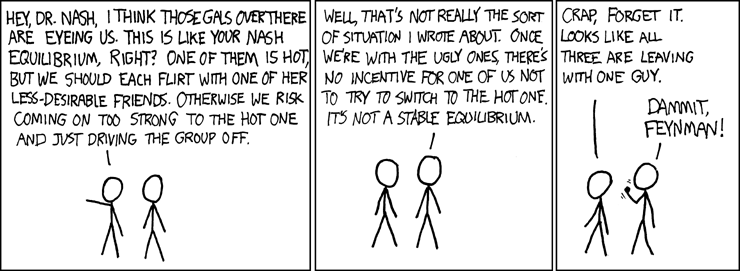
xkcd is surreal sometimes, sometimes plain weird.

PS: This is where I stole my pic from.

Sunday, December 03, 2006

In the beginning was the nerd

"Sir: In your otherwise beautiful poem 'The Vision of Sin', there is a verse which reads - 'Every moment dies a man, Every moment one is born.' It must be manifest that if this were true, the population of the world would be at a standstill...I would suggest that in the next edition of your poem you have it read - 'Every moment dies a man, Every moment 1 1/16 is born'...The actual figure is so long I cannot get it onto a line, but the believe the figure 1 1/16 will be sufficiently accurate for poetry."

- Charles Babbage (letter to Lord Tennyson)


From Doron Swade's The Cogwheel Brain.

The book does not clarify this, but I certainly hope to God he was kidding. Though it would surprise no one if the 'father' of computer engineering was a nerd.

Wednesday, November 15, 2006

Math is War

Reductio ad absurdum, which Euclid loved so much, is one of a mathematician's finest weapons. It is a far finer gambit than any chess play: a chess player may offer the sacrifice of a pawn or even a piece, but a mathematician offers the game.

-G. H. Hardy (A Mathematician's Apology)

Wow. Hardy sure knew how to write.

Incidentally, this sounds even better in Bollywood hindi/urdu ;) : "shatranj me khiladi to bas ek pyanda ya ek mohra daanv pe lagata hai. Par Euclid wo shaqs hai jo saari baazi daanv pe lagaya karta tha."

PS: No disrespect to Hardy, of course.

Tuesday, November 14, 2006

Story my professor told me

An engineering and a mathematics professor go on a camping trip. And because they did not consume enough Ramen in grad school, they carry a couple of packets with them, so they can have some for breakfast as well as dinner. Every morning and evening one of them has to light a fire, go down the hill they are camping on to get water from a river, boil Ramen in the water, and then wash the Ramen pot back by the river.

The first night the mathematics prof does everything according to plan. He lights the fire, gets the water, cooks Ramen, then washes the pot and brings it back. The next evening, its the engineer's turn, and he decides to do his friend a favor. He covers the dying evening fire with brush so its easy to relight in the morning, and he brings back water in the pot after washing.

The mathematician wakes up promptly at six. He notices the water in the pot, and the dormant fire. He promptly throws out the water, and extinguishes the embers. Rubbing his palms together with satisfaction, he says: "Now that reduces it to a problem with a previously-known solution."

Friday, November 03, 2006

Dawkins clips again (Haggard and Al-Khatab)

I did not know that Dawkins had done a BBC documentary, The Root of All Evil? in January 2006. This clip, that seems to be all over with the recent evangelical scandal, tipped me off. The most fascinating part of the clip is the pained expression on Dawkins' face, as Haggard bludgeons him to silence by the sheer arrogance of his humility.

Searching for other clips, I found this one about an interesting character called Yousef al-Khatab, aka Joseph Cohen, a secular New York Jew convert to Islam.

Dawkins is remarkably patient with him, but loses it in the end.


Yousef: ...Correct yourself, fix your society, fix your women.
Dawkins: Fix my women! Its not my business. Its my women's business.
Yousef: When you take women and dress them like whores on the street...
Dawkins: I don't dress women. They dress themselves!
Yousef: But you allow women to go on the streets dressed like this. What's going on with your society?


So he grew up in New York, and does not realize that men cannot 'fix' women? The good thing about being a fundamentalist is that, when you lose an argument, you do not even know it.

But what was saddest was the lost expression on Dawkins' face, as he tried to reason with these men, and failed each time. I don't know if he ever was naive enough to imagine he could use modus ponens with these people, but this sure looked like a learning experience for him.

I was getting bored with Dawkins' god-baiting, but now I think he is really doing us a favor.

Friday, October 27, 2006

Constructing HAL

An interesting presentation by Doug Lenat, AI pioneer and founder of cycorp, at google.


Cyc plans to feed all the information in the world into a computer, and then let the computer use first order logic to reason with the information to answer questions. Now before we go all 2001 over this, its interesting that Lenat has been working at it for over twenty years, and the system can now answer questions like 'Is President Bush inhaling or exhaling right now?' correctly, with an 'I don't know'.

To be fair, some of the examples in the presentation are impressive, but is it a victory for AI, or for Moore's law? I am not a great fan of the Deep Blue approach to AI problems. It seems the way to solve an AI problem is to destroy it.

On the other hand, Lenat does point out a very serious problem with gradual learn-by-experience approaches: a Catch-22 situation where the less the system already knows, the harder it is for it to learn further or evolve. So classical AI might be a good bootstrap to give learning systems a headstart. That is actually a very good idea, and I haven't seen anyone doing that.

Saturday, October 21, 2006

Some of us just go one God further

"Usually they say they were expecting a man in a wheelchair who can't talk. They confuse me with Stephen Hawking.
Is he going to hell too?
I reckon so...
Ya, maybe so, maybe so...God doesn't like black holes..."
Colbert interviews Richard Dawkins.


I idolized Dawkins as a teen, but he is getting a little repetitive. Still, for nostalgia's sake.