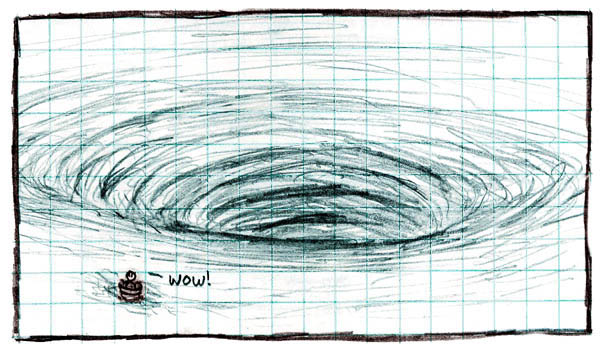
'Research ! A mere excuse for idleness; it has never achieved, and will never achieve any results of the slightest value.'
- Benjamin Jowett (1817-1893)
(English theologian, master of Balliol College, Oxford)
Someone got it right ;) .
Friday, December 01, 2006

Wednesday, November 22, 2006
Only connect
Nerd trivia.
What is common to the alphabets x, q, z, and i, in the context of the Internet?
Answer: If you type x,q, i or z.com as the URL, it works. No, the other letters don't.
There are six single-letter domain names on the internet, which were registered before ICANN refused to distribute any more in 1993. They are, q.com for Qwest Communications; x.com owned by PayPal (it still works); z.com for Nissan's Z cars; i.net, a domain name registration company; q.net, for Q Networks; and x.org for the X.Org Foundation.
ICANN stopped giving out single-letter second-level domain names in 1993, because it was afraid that 'two-dot' domain names may not be enough to cover all the websites in the world, and it may need to use these single letter domain names to introduce another level (eg,: google.x.com ).
More nerd trivia.
What is common to the alphabets x, q, z, and i, in the context of the Internet?
Answer: If you type x,q, i or z.com as the URL, it works. No, the other letters don't.
There are six single-letter domain names on the internet, which were registered before ICANN refused to distribute any more in 1993. They are, q.com for Qwest Communications; x.com owned by PayPal (it still works); z.com for Nissan's Z cars; i.net, a domain name registration company; q.net, for Q Networks; and x.org for the X.Org Foundation.
ICANN stopped giving out single-letter second-level domain names in 1993, because it was afraid that 'two-dot' domain names may not be enough to cover all the websites in the world, and it may need to use these single letter domain names to introduce another level (eg,: google.x.com ).
More nerd trivia.
Wednesday, November 15, 2006
Math is War
Reductio ad absurdum, which Euclid loved so much, is one of a mathematician's finest weapons. It is a far finer gambit than any chess play: a chess player may offer the sacrifice of a pawn or even a piece, but a mathematician offers the game.
-G. H. Hardy (A Mathematician's Apology)
Wow. Hardy sure knew how to write.
Incidentally, this sounds even better in Bollywood hindi/urdu ;) : "shatranj me khiladi to bas ek pyanda ya ek mohra daanv pe lagata hai. Par Euclid wo shaqs hai jo saari baazi daanv pe lagaya karta tha."
PS: No disrespect to Hardy, of course.
Tuesday, November 14, 2006
Story my professor told me
An engineering and a mathematics professor go on a camping trip. And because they did not consume enough Ramen in grad school, they carry a couple of packets with them, so they can have some for breakfast as well as dinner. Every morning and evening one of them has to light a fire, go down the hill they are camping on to get water from a river, boil Ramen in the water, and then wash the Ramen pot back by the river.
The first night the mathematics prof does everything according to plan. He lights the fire, gets the water, cooks Ramen, then washes the pot and brings it back. The next evening, its the engineer's turn, and he decides to do his friend a favor. He covers the dying evening fire with brush so its easy to relight in the morning, and he brings back water in the pot after washing.
The mathematician wakes up promptly at six. He notices the water in the pot, and the dormant fire. He promptly throws out the water, and extinguishes the embers. Rubbing his palms together with satisfaction, he says: "Now that reduces it to a problem with a previously-known solution."
The first night the mathematics prof does everything according to plan. He lights the fire, gets the water, cooks Ramen, then washes the pot and brings it back. The next evening, its the engineer's turn, and he decides to do his friend a favor. He covers the dying evening fire with brush so its easy to relight in the morning, and he brings back water in the pot after washing.
The mathematician wakes up promptly at six. He notices the water in the pot, and the dormant fire. He promptly throws out the water, and extinguishes the embers. Rubbing his palms together with satisfaction, he says: "Now that reduces it to a problem with a previously-known solution."
Sunday, November 12, 2006
Saturday, November 11, 2006
If I were called in to construct a religion...
Philip Larkin reads his poem Water.
The text is here.
Few poems showcase Larkin's technical mastery as this poem. He sounds facetious when the poem starts: whoever gets called to construct a religion? The second line seems even stranger, and you wonder if he has any idea what he is talking about. But when the poem ends, merely twelve lines later, and only thirty seconds in his reading, he has already moved from his inane premise to build the sense of a religious experience.
Like many agnostics, Larkin had a clearer conception of what religion tries to answer, than the very religious.
There is one poem where he does it even better, his celebrated High Windows . Who else could write a poem that starts with the f-word, and ends in a church, and so convincingly?
Philip Larkin reads his poem Water.
The text is here.
Few poems showcase Larkin's technical mastery as this poem. He sounds facetious when the poem starts: whoever gets called to construct a religion? The second line seems even stranger, and you wonder if he has any idea what he is talking about. But when the poem ends, merely twelve lines later, and only thirty seconds in his reading, he has already moved from his inane premise to build the sense of a religious experience.
Like many agnostics, Larkin had a clearer conception of what religion tries to answer, than the very religious.
There is one poem where he does it even better, his celebrated High Windows . Who else could write a poem that starts with the f-word, and ends in a church, and so convincingly?
Friday, November 10, 2006
I work all day, and get half drunk at night...
The last poem Philip Larkin wrote was Aubade. An aubade is a special kind of poem, about two lovers separating at dawn. Larkin wrote his aubade to life. There is an audio recording online of him reading the poem. It is one of the most beautiful things I have ever heard.
For the visually inclined, here's a video of Alan Bennett reading Aubade, set to New Order's 'Your Silent Face'. But be warned, Alan Bennett is an excellent actor, but there ain't nothing like Aubade in the old man's voice himself :) .
And simply because I love it so much, I'll copy the poem below.
The poem's sense of depression is almost numbing, and not for everyday, but when Keats said that truth is beauty, few poets took him seriously, but Larkin did. His poems always saw life 'plain as a wardrobe', and when he faces death, he cannot see it any differently.
What is strange is, what is Larkin doing in a Crowded House video?
For the visually inclined, here's a video of Alan Bennett reading Aubade, set to New Order's 'Your Silent Face'. But be warned, Alan Bennett is an excellent actor, but there ain't nothing like Aubade in the old man's voice himself :) .
And simply because I love it so much, I'll copy the poem below.
I work all day, and get half drunk at night.
Waking at four to soundless dark, I stare.
In time the curtain edges will grow light.
Till then I see what's really always there:
Unresting death, a whole day nearer now,
Making all thought impossible but how
And where and when I shall myself die.
Arid interrogation: yet the dread
Of dying, and being dead,
Flashes afresh to hold and horrify.
The mind blanks at the glare. Not in remorse
- The good not used, the love not given, time
Torn off unused - nor wretchedly because
An only life can take so long to climb
Clear of its wrong beginnings, and may never:
But at the total emptiness forever,
The sure extinction that we travel to
And shall be lost in always. Not to be here,
Not to be anywhere,
And soon; nothing more terrible, nothing more true.
This is a special way of being afraid
No trick dispels. Religion used to try,
That vast moth-eaten musical brocade
Created to pretend we never die,
And specious stuff that says no rational being
Can fear a thing it cannot feel, not seeing
that this is what we fear - no sight, no sound,
No touch or taste or smell, nothing to think with,
Nothing to love or link with,
The anaesthetic from which none come round.
And so it stays just on the edge of vision,
A small unfocused blur, a standing chill
That slows each impulse down to indecision
Most things may never happen: this one will,
And realisation of it rages out
In furnace fear when we are caught without
People or drink. Courage is no good:
It means not scaring others. Being brave
Lets no-one off the grave.
Death is no different whined at than withstood.
Slowly light strengthens, and the room takes shape.
It stands plain as a wardrobe, what we know,
Have always known, know that we can't escape
Yet can't accept. One side will have to go.
Meanwhile telephones crouch, getting ready to ring
In locked-up offices, and all the uncaring
Intricate rented world begins to rouse.
The sky is white as clay, with no sun.
Work has to be done.
Postmen like doctors go from house to house.
The poem's sense of depression is almost numbing, and not for everyday, but when Keats said that truth is beauty, few poets took him seriously, but Larkin did. His poems always saw life 'plain as a wardrobe', and when he faces death, he cannot see it any differently.
What is strange is, what is Larkin doing in a Crowded House video?
Monday, November 06, 2006
Taal sa hilta raha man
Dhar gaye mehndi rache
do haath jal me deep
janm-janmo taal sa hilta raha man
baanchte hum reh gaye
antarkatha
swarnakesha-
geetbandhuo ki vyatha
le gaya chunkar kamal-
koi hathi yuvraj
der tak shaival-sa hilta raha man
jangalo ka dukh
taton ki traasadi
bhool, sukh se so gayi-
koi nadi
thak gayi ladti hawaon se
abhaagi naanv,
aur jheene paal-sa hilta raha man
tum gaye kya-
jag hua andha kua
rail chhuti, reh gaya keval dhua
gungunate hum bhari aankhen-
phire sab raat,
haath ke rumal sa hilta raha man.
- Kishan Saroj
I had been planning to translate it to english, but I don't know if it will work in a translation. Definitely not in one by my hands.
You can read the poem in devanagri here .
The fonts can be downloaded here .
Friday, November 03, 2006
Dawkins clips again (Haggard and Al-Khatab)
I did not know that Dawkins had done a BBC documentary, The Root of All Evil? in January 2006. This clip, that seems to be all over with the recent evangelical scandal, tipped me off. The most fascinating part of the clip is the pained expression on Dawkins' face, as Haggard bludgeons him to silence by the sheer arrogance of his humility.
Searching for other clips, I found this one about an interesting character called Yousef al-Khatab, aka Joseph Cohen, a secular New York Jew convert to Islam.
Dawkins is remarkably patient with him, but loses it in the end.
So he grew up in New York, and does not realize that men cannot 'fix' women? The good thing about being a fundamentalist is that, when you lose an argument, you do not even know it.
But what was saddest was the lost expression on Dawkins' face, as he tried to reason with these men, and failed each time. I don't know if he ever was naive enough to imagine he could use modus ponens with these people, but this sure looked like a learning experience for him.
I was getting bored with Dawkins' god-baiting, but now I think he is really doing us a favor.
Searching for other clips, I found this one about an interesting character called Yousef al-Khatab, aka Joseph Cohen, a secular New York Jew convert to Islam.
Dawkins is remarkably patient with him, but loses it in the end.
Yousef: ...Correct yourself, fix your society, fix your women.
Dawkins: Fix my women! Its not my business. Its my women's business.
Yousef: When you take women and dress them like whores on the street...
Dawkins: I don't dress women. They dress themselves!
Yousef: But you allow women to go on the streets dressed like this. What's going on with your society?
So he grew up in New York, and does not realize that men cannot 'fix' women? The good thing about being a fundamentalist is that, when you lose an argument, you do not even know it.
But what was saddest was the lost expression on Dawkins' face, as he tried to reason with these men, and failed each time. I don't know if he ever was naive enough to imagine he could use modus ponens with these people, but this sure looked like a learning experience for him.
I was getting bored with Dawkins' god-baiting, but now I think he is really doing us a favor.
Match Point
I liked Match Point, what seemed like Woody Allen's interpretation of Crime and Punishment. Though the movie does not see any final redemption for its Raskolnikov. As a character scoffs: 'Faith is the path of least resistance'.
"It would be fitting if I were apprehended... and punished. At least there would be some small sign of justice - some small measure of hope for the possibility of meaning."
It does come across as pretentious at a couple of points, but I am willing to tolerate a hint of pretension, so long as a movie is interesting.
The Woody Allen movie I disliked was Manhattan, which was pretentious about quite stupid things.
Monday, October 30, 2006
Fire and Ice
A long discussion on sepia mutiny today about science and religion. Reminded me of this poem.
Ah, the not so gentle Frost. I wish we saw him more often.
The poem could be an allegory for so many things, but if science is fire and religion is ice, then I'd say it is a tossup between fire and ice.
Some say the world will end in fire;
Some say in ice.
From what I've tasted of desire
I hold with those who favor fire.
But if it had to perish twice,
I think I know enough of hate
To know that for destruction ice
Is also great
And would suffice.
Ah, the not so gentle Frost. I wish we saw him more often.
The poem could be an allegory for so many things, but if science is fire and religion is ice, then I'd say it is a tossup between fire and ice.
Friday, October 27, 2006
Constructing HAL
An interesting presentation by Doug Lenat, AI pioneer and founder of cycorp, at google.
Cyc plans to feed all the information in the world into a computer, and then let the computer use first order logic to reason with the information to answer questions. Now before we go all 2001 over this, its interesting that Lenat has been working at it for over twenty years, and the system can now answer questions like 'Is President Bush inhaling or exhaling right now?' correctly, with an 'I don't know'.
To be fair, some of the examples in the presentation are impressive, but is it a victory for AI, or for Moore's law? I am not a great fan of the Deep Blue approach to AI problems. It seems the way to solve an AI problem is to destroy it.
On the other hand, Lenat does point out a very serious problem with gradual learn-by-experience approaches: a Catch-22 situation where the less the system already knows, the harder it is for it to learn further or evolve. So classical AI might be a good bootstrap to give learning systems a headstart. That is actually a very good idea, and I haven't seen anyone doing that.
Cyc plans to feed all the information in the world into a computer, and then let the computer use first order logic to reason with the information to answer questions. Now before we go all 2001 over this, its interesting that Lenat has been working at it for over twenty years, and the system can now answer questions like 'Is President Bush inhaling or exhaling right now?' correctly, with an 'I don't know'.
To be fair, some of the examples in the presentation are impressive, but is it a victory for AI, or for Moore's law? I am not a great fan of the Deep Blue approach to AI problems. It seems the way to solve an AI problem is to destroy it.
On the other hand, Lenat does point out a very serious problem with gradual learn-by-experience approaches: a Catch-22 situation where the less the system already knows, the harder it is for it to learn further or evolve. So classical AI might be a good bootstrap to give learning systems a headstart. That is actually a very good idea, and I haven't seen anyone doing that.
Thursday, October 26, 2006
Only connect
Nerd Trivia.
Connect the Unabomber, pornography, Lord Byron, and a concurrent programming language.
Answer: David Gelernter
David Gelernter, professor at Yale, and a target of the Unabomber, invented the concurrent programming language Linda, named after Linda Lovelace (the star of Deep Throat) as a twisted sort of joke, as the only other woman to have a programming language named after her is also a Lovelace: Ada, daughter of Lord Byron.
You can't make this stuff up.
Connect the Unabomber, pornography, Lord Byron, and a concurrent programming language.
Answer: David Gelernter
David Gelernter, professor at Yale, and a target of the Unabomber, invented the concurrent programming language Linda, named after Linda Lovelace (the star of Deep Throat) as a twisted sort of joke, as the only other woman to have a programming language named after her is also a Lovelace: Ada, daughter of Lord Byron.
You can't make this stuff up.
Saturday, October 21, 2006
Some of us just go one God further
"Usually they say they were expecting a man in a wheelchair who can't talk. They confuse me with Stephen Hawking.Colbert interviews Richard Dawkins.
Is he going to hell too?
I reckon so...
Ya, maybe so, maybe so...God doesn't like black holes..."
I idolized Dawkins as a teen, but he is getting a little repetitive. Still, for nostalgia's sake.
Friday, September 15, 2006
A day before the (Moharram) processions were due to take place, a young [Sunni] Saudi prince told me he could not understand why the Shias had to scourge themselves. "The events they are remembering took place long before they were born, and there's no reason for them to blame themselves now because there's nothing they can do to stop what happened."
-Michael Field (Inside the Arab World)
It is gratifying to see how reasonable people can be about religion - if it is not theirs.
Friday, August 25, 2006
In Minstrels Today.
Guest poem sent in by Lakshmi Jagad.
"On Death, without Exaggeration"
It can't take a joke,
find a star, make a bridge.
It knows nothing about weaving, mining, farming,
building ships, or baking cakes.
In our planning for tomorrow,
it has the final word,
which is always beside the point.
It can't even get the things done
that are part of its trade:
dig a grave,
make a coffin,
clean up after itself.
Preoccupied with killing,
it does the job awkwardly,
without system or skill.
As though each of us were its first kill.
Oh, it has its triumphs,
but look at its countless defeats,
missed blows,
and repeat attempts!
Sometimes it isn't strong enough
to swat a fly from the air.
Many are the caterpillars
that have outcrawled it.
All those bulbs, pods,
tentacles, fins, tracheae,
nuptial plumage, and winter fur
show that it has fallen behind
with its halfhearted work.
Ill will won't help
and even our lending a hand with wars and coups d'etat
is so far not enough.
Hearts beat inside eggs.
Babies' skeletons grow.
Seeds, hard at work, sprout their first tiny pair of leaves
and sometimes even tall trees fall away.
Whoever claims that it's omnipotent
is himself living proof
that it's not.
There's no life
that couldn't be immortal
if only for a moment.
Death
always arrives by that very moment too late.
In vain it tugs at the knob
of the invisible door.
As far as you've come
can't be undone.
-- Wislawa Szymborska
"On Death, without Exaggeration"
It can't take a joke,
find a star, make a bridge.
It knows nothing about weaving, mining, farming,
building ships, or baking cakes.
In our planning for tomorrow,
it has the final word,
which is always beside the point.
It can't even get the things done
that are part of its trade:
dig a grave,
make a coffin,
clean up after itself.
Preoccupied with killing,
it does the job awkwardly,
without system or skill.
As though each of us were its first kill.
Oh, it has its triumphs,
but look at its countless defeats,
missed blows,
and repeat attempts!
Sometimes it isn't strong enough
to swat a fly from the air.
Many are the caterpillars
that have outcrawled it.
All those bulbs, pods,
tentacles, fins, tracheae,
nuptial plumage, and winter fur
show that it has fallen behind
with its halfhearted work.
Ill will won't help
and even our lending a hand with wars and coups d'etat
is so far not enough.
Hearts beat inside eggs.
Babies' skeletons grow.
Seeds, hard at work, sprout their first tiny pair of leaves
and sometimes even tall trees fall away.
Whoever claims that it's omnipotent
is himself living proof
that it's not.
There's no life
that couldn't be immortal
if only for a moment.
Death
always arrives by that very moment too late.
In vain it tugs at the knob
of the invisible door.
As far as you've come
can't be undone.
-- Wislawa Szymborska
Monday, June 26, 2006
Saturday, June 24, 2006
Thunder Road: The Dirge
Bruce Springsteen has a different version of Thunder Road in his 'Live 1975-1985' collection. It is a tired dirge to youth and ambition, unlike the album version, which was a celebration, powerful and desperate at the same time.
The live version is a distinct song in its own right.
You don't believe him when he sings this in the original, but in the live version you do. Springsteen sounds old. And the girl seems much more important.In the album version, he is not talking to the girl. Sure she is addressed, but it is merely incidental. You can see the guy is wrapped up in what the future will bring him. It is Springsteen, of course, and you know that the future did bring him a lot, and the song becomes a huge celebration of that special belief that people have in their uniqueness, which was proven to be true in dear Bruce's case, and when you are young, you think it will be proven in your case too.
The live version came as a shock to me. Coming from Bruce the Boss, it should have been a gloat as much as a song. Who can sing the song with a smugger, more satisfied smile? But it is strange what he makes of it. Was Springsteen disappointed in any way? Well, I would have been too, if I had released such horribly mediocre albums as Human Touch and Lucky Town to follow up Darkness on the Edge!
Kidding. But only partly. We all end up being disappointed to some extent. Not with the world, but with ourselves. We are not the perfect, ideal heroes we see ourselves. As we grow, we catch ourselves lying, cheating, manipulating, compromising, and getting used to the mediocre, and we realize we are no better.
Only, you pull into another town of losers. Maybe fewer losers, if you are lucky. But losers, nonetheless.
Yes, I am not exactly upbeat today.
The live version is a distinct song in its own right.
So you're scared and you're thinking
That maybe we ain't that young anymore
You don't believe him when he sings this in the original, but in the live version you do. Springsteen sounds old. And the girl seems much more important.In the album version, he is not talking to the girl. Sure she is addressed, but it is merely incidental. You can see the guy is wrapped up in what the future will bring him. It is Springsteen, of course, and you know that the future did bring him a lot, and the song becomes a huge celebration of that special belief that people have in their uniqueness, which was proven to be true in dear Bruce's case, and when you are young, you think it will be proven in your case too.
The live version came as a shock to me. Coming from Bruce the Boss, it should have been a gloat as much as a song. Who can sing the song with a smugger, more satisfied smile? But it is strange what he makes of it. Was Springsteen disappointed in any way? Well, I would have been too, if I had released such horribly mediocre albums as Human Touch and Lucky Town to follow up Darkness on the Edge!
Kidding. But only partly. We all end up being disappointed to some extent. Not with the world, but with ourselves. We are not the perfect, ideal heroes we see ourselves. As we grow, we catch ourselves lying, cheating, manipulating, compromising, and getting used to the mediocre, and we realize we are no better.
It's a town full of losers
And I'm pulling out of here to win.
Only, you pull into another town of losers. Maybe fewer losers, if you are lucky. But losers, nonetheless.
Yes, I am not exactly upbeat today.
Friday, June 23, 2006
Gieve Patel: Desi Doctor Poet
It takes much time to kill a tree,- Gieve Patel
Not a simple jab of the knife
Will do it. It has grown
Slowly consuming the earth,
Rising out if it, feeding
Upon its crust, absorbing
Years of sunlight, air, water,
And out of its leprous hide
Sprouting leaves.
So hack and chop
But this alone won't do it.
Not so much pain will do it.
The bleeding bark will heal
And from close to the ground
Will rise curled green twigs,
Miniature boughs
Which if unchecked will expand again
To former size.
No,
The root is to be pulled out –
Out of the anchoring earth;
It is to be roped, tied,
And pulled out-snapped out
Or pulled out entirely,
Out from the earth-cave,
And the strength of the tree exposed,
The source, white and wet,
The most sensitive, hidden
For years inside the earth.
Then the matter
Of scorching and choking
In sun and air,
Browning, hardening,
Twisting, withering,
And then it is done.
A killer of a poem, if you will excuse the lousy pun. I always admired its surgical precision, and today I discovered the poet was a doctor. Another poem by Gieve Patel, I discovered while searching for this one.
it makes sense not
to have the body
seamless,
hermetically sealed, a
non-orificial
box of incorruptibles.
Saturday, May 06, 2006
The Seventh Seal
I saw The Seventh Seal today. It was perhaps Ingmar Bergman's first major movie, and you can tell. Not in the sense that it is an immature or flawed work, but by the theme. The movie is about the Godless universe, the pointlessness of life, the inevitability of death, and the overall stupidity of it all. Only a fresh young film director can decide he shall make a movie that will ask the most important questions ever. And the central premise of the movie is breathtaking in its theatricality - death confronts a knight back from the Crusades in medieval times, and tells him he has to die. The knight challenges death to a game of chess. If he wins, death has to let him go. The very idea: a medieval knight and death play chess for the knight's life. Yet, it does not appear absurd in the movie. In Bergman's words:
'It was a delicate and dangerous artistic move, which could have failed. Suddenly, an actor appears in the whiteface, dressed all in black, and announces that he is Death. Everyone accepted the dramatic feat that he was Death, instead of saying "Come on now, don't try to put something over on us! You can't fool us! We can see that you are just a talented actor who is painted white and clad in black! You're not Death at all!".'
But somehow it does not happen.
One of the best scenes in the movie is where the knight Antonius Block(played by Max von Sydow) visits an old(even by middle ages standards ;) ) church. He goes to confession and death masquerades as the priest(screenplay translation from Swedish, excerpt from here):
The KNIGHT is kneeling before a small altar. It is dark and quiet around him.
The air is cool and musty. Pictures of saints look down on him with stony
eyes. Christ's face is turned upwards, His mouth open as if in a cry of
anguish. On the ceiling beam there is a representation of a hideous devil
spying on a miserable human being. The KNIGHT hears a sound from the
confession booth and approaches it. The face of DEATH appears behind the
grille for an instant, but the KNIGHT doesn't see him.
KNIGHT
I want to talk to you as openly as I can, but my heart is empty.
DEATH doesn't answer.
KNIGHT
The emptiness is a mirror turned towards my own face. I see myself in it, and I am filled with fear and disgust.
DEATH doesn't answer.
KNIGHT
Through my indifference to my fellow men, I have isolated myself from their company. Now I live in a world of phantoms. I am imprisoned in my dreams and fantasies.
DEATH
And yet you don't want to die.
KNIGHT
Yes, I do.
DEATH
What are you waiting for?
KNIGHT
I want knowledge.
DEATH
You want guarantees?
KNIGHT
Call it whatever you like. Is it so cruelly inconceivable to grasp God with the senses? Why should He hide himself in a mist of half-spoken promises and unseen miracles?
DEATH doesn't answer.
KNIGHT
How can we have faith in those who believe when we can't have faith in ourselves? What is going to happen to those of us who want to believe but aren't able to? And what is to become of those who neither want to nor are capable of believing?
The KNIGHT stops and waits for a reply, but no one speaks or answers him. There is complete silence.
KNIGHT
Why can't I kill God within me? Why does He lives on in this painful and humiliating way even though I curse Him and want to tear Him out of my heart? Why, in spite of everything, is He a baffling reality that I can't shake off? Do you hear me?
DEATH
Yes, I hear you.
KNIGHT
I want knowledge, not faith, not suppositions, but knowledge. I want God to stretch out His hand towards me, reveal Himself and speak to me.
DEATH
But He remains silent.
KNIGHT
I call out to Him in the dark but no one seems to be there.
DEATH
Perhaps no one is there.
KNIGHT
Then life is an outrageous horror. No one can live in the face of death, knowing that all is nothingness.
DEATH
Most people never reflect about either death or the futility of life.
KNIGHT
But one day they will have to stand at that last moment of life and look towards the darkness.
DEATH
When that day comes ...
KNIGHT
In our fear, we make an image, and that image we call God.
Wow!
Quoting Larkin:
'And saying so to some
Means nothing; others it leaves
Nothing to be said.'
For me it was the latter.
'It was a delicate and dangerous artistic move, which could have failed. Suddenly, an actor appears in the whiteface, dressed all in black, and announces that he is Death. Everyone accepted the dramatic feat that he was Death, instead of saying "Come on now, don't try to put something over on us! You can't fool us! We can see that you are just a talented actor who is painted white and clad in black! You're not Death at all!".'
But somehow it does not happen.
One of the best scenes in the movie is where the knight Antonius Block(played by Max von Sydow) visits an old(even by middle ages standards ;) ) church. He goes to confession and death masquerades as the priest(screenplay translation from Swedish, excerpt from here):
The KNIGHT is kneeling before a small altar. It is dark and quiet around him.
The air is cool and musty. Pictures of saints look down on him with stony
eyes. Christ's face is turned upwards, His mouth open as if in a cry of
anguish. On the ceiling beam there is a representation of a hideous devil
spying on a miserable human being. The KNIGHT hears a sound from the
confession booth and approaches it. The face of DEATH appears behind the
grille for an instant, but the KNIGHT doesn't see him.
KNIGHT
I want to talk to you as openly as I can, but my heart is empty.
DEATH doesn't answer.
KNIGHT
The emptiness is a mirror turned towards my own face. I see myself in it, and I am filled with fear and disgust.
DEATH doesn't answer.
KNIGHT
Through my indifference to my fellow men, I have isolated myself from their company. Now I live in a world of phantoms. I am imprisoned in my dreams and fantasies.
DEATH
And yet you don't want to die.
KNIGHT
Yes, I do.
DEATH
What are you waiting for?
KNIGHT
I want knowledge.
DEATH
You want guarantees?
KNIGHT
Call it whatever you like. Is it so cruelly inconceivable to grasp God with the senses? Why should He hide himself in a mist of half-spoken promises and unseen miracles?
DEATH doesn't answer.
KNIGHT
How can we have faith in those who believe when we can't have faith in ourselves? What is going to happen to those of us who want to believe but aren't able to? And what is to become of those who neither want to nor are capable of believing?
The KNIGHT stops and waits for a reply, but no one speaks or answers him. There is complete silence.
KNIGHT
Why can't I kill God within me? Why does He lives on in this painful and humiliating way even though I curse Him and want to tear Him out of my heart? Why, in spite of everything, is He a baffling reality that I can't shake off? Do you hear me?
DEATH
Yes, I hear you.
KNIGHT
I want knowledge, not faith, not suppositions, but knowledge. I want God to stretch out His hand towards me, reveal Himself and speak to me.
DEATH
But He remains silent.
KNIGHT
I call out to Him in the dark but no one seems to be there.
DEATH
Perhaps no one is there.
KNIGHT
Then life is an outrageous horror. No one can live in the face of death, knowing that all is nothingness.
DEATH
Most people never reflect about either death or the futility of life.
KNIGHT
But one day they will have to stand at that last moment of life and look towards the darkness.
DEATH
When that day comes ...
KNIGHT
In our fear, we make an image, and that image we call God.
Wow!
Quoting Larkin:
'And saying so to some
Means nothing; others it leaves
Nothing to be said.'
For me it was the latter.
Subscribe to:
Posts (Atom)